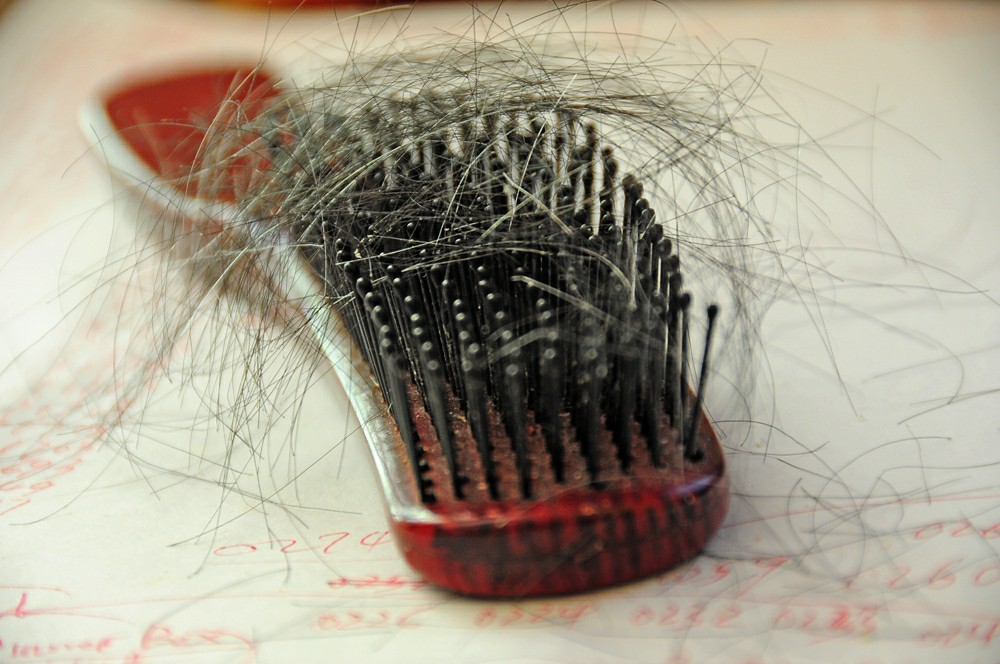
Heavy hair fall alone does not pose any threat to health. But the thinned hair is an extremely serious test for self-esteem of both women and men. Together with hair, people lose confidence in themselves and their attractiveness, and this is already fraught with neurosis and stress.
In addition, the weakening of the hair follicles is a sign of many diseases and pathological conditions. That is why you should not take alopecia lightly.
Why do we have a heavy hair fall?
The causes of hair loss can be quite innocent and associated with some external factors, but sometimes it is a sign of formidable diseases that threaten not only the hair, but also health in general. Therefore, the question “why hair falls out” should be asked first of all to the doctor, and not to the hairdresser or the search engine on the Internet.
Problems of the condition of the hair are handled by a trichologist. After reviewing the complaints, he can prescribe a number of studies, in particular a blood test for hormones, a general and biochemical blood test, a blood test for ferritin, for syphilis, an immunogram, a phototrichogram for studying the condition of the hair shaft and bulb, trichoscopy, and tests for fungal infections.
In some cases, consultation with other specialists — an endocrinologist, a nutritionist, a gastroenterologist, and others — will be required — as we have already said, hair loss often accompanies diseases that seem to be unrelated to hair.
However, wondering why hair falls out and what to do about it, do not rush to panic. There is such a thing as physiological hair loss. We lose hair daily. The hair has a lifespan of about 3 years, reaching this age, it falls out, and a new one begins to grow in its place.
On average, we lose about 100 hair per day. This is a little, especially when you consider that on average a person has 50-150 thousand hair. Some of them fall out during combing, and some during head washing. If you haven’t washed your hair for a long time, the amount of hair falling out during washing may be higher than usual, and there is no reason to worry.
It’s worth thinking about a visit to the doctor if you began to notice that there is much more hair left on the comb than usual, or if you find in the morning on the pillow not a few hairs, but whole strands. And even more so, it should be worried if the hair falls out so intensely that whole areas devoid of vegetation appear on the head.
External and internal causes of hair loss
Why is hair falling out? There are many reasons, and all of them are conditionally divided into two categories – internal and external.
Internal:
Autoimmune diseases that cause hair loss. With autoimmune diseases, the body’s defense system fails and it starts attacking not the aggressors – bacteria and viruses – but the cells of the body itself.
Autoimmune diseases are characterized by nesting, or focal alopecia, a condition in which small islands of baldness appear on the scalp, which merge as the disease develops, forming vast areas devoid of vegetation. Alopecia associated with autoimmune reactions is difficult to treat, but it is rare in only 0.5% of cases.
Change in hormonal levels. Problems with hormones often affect the condition of the hair, both in men and women. The hormone-dependent types of alopecia are primarily related to androgenetic alopecia, which, alas, is familiar to many men and a small number of women. Androgenetic alopecia accounts for about 95% of all cases of hair loss in men and, according to some reports, 20% of cases in women.
This type of baldness is associated with male sex hormones – androgens. With androgenetic alopecia in men, hair begins to intensively fall out in the frontal and parietal parts of the head, and in women – in the middle parting. Lost hair is replaced by fluffy, and about 10 years after the onset of the disease, they disappear, because the follicles die, and their mouths are tightened by connective tissue.
But not only androgens can be responsible for hair loss. Alopecia is accompanied by many other hormonal changes, for example: pregnancy, childbirth and abortion, thyroid disease and uncontrolled intake of any hormonal drugs, even such harmless ones as birth control pills.
However, in all these cases, diffuse alopecia is observed – uniform hair loss throughout the head. The formation of clearly defined bald patches or bald patches for diffuse alopecia is uncharacteristic.
Stress. Neurosis, depression, and simply long-term nervous tension – all this often leads to hair loss. The situation may be aggravated by the fact that some types of antidepressants prescribed in such conditions, by themselves, may have weakening and hair loss among the side effects. Stress is characterized by diffuse alopecia.
External:
Injuries. If the follicles were damaged as a result of a wound or burn, they speak of cicatricial alopecia. Injuries include inflammation scars, for example, after an infectious disease of the scalp. Cicatricial alopecia accounts for approximately 1% of all cases of this disease. Alas, this type of baldness is not amenable to conservative treatment: if the follicles die, no drugs and cosmetics can revive them. The only way out in this situation is a hair transplant.
Taking medication. Hair loss is a fairly common side effect of many medications. Alopecia can lead to the use of antidepressants, interferons, retinoids, beta-blockers, antipsychotics, anticonvulsants, thyreostatics, heparin. Medical alopecia is also manifested by diffuse hair loss. But it is important to know that taking medication does not immediately weaken the follicles. Hair begins to fall out about 3 months after the start of drug therapy. Therefore, when preparing for a visit to a trichologist, be sure to make a list of not only the medicines that you are taking now, but also those that you took about 3 months ago.
Improper nutrition. The condition of the hair largely depends on our diet. With a lack of iron, protein and many vitamins and minerals, hair can weaken and fall out.
Mechanical impact. Too tight hairstyles or tight hats put extra strain on the follicles. Despite the fact that the hair follicle sits firmly in the skin, daily pulling of hair into a knot or “ponytail” leads to the fact that the hair still falls prematurely.
If hair falls out: step by step instructions
So, it seems to you that you are starting to lose hair. Before you sound the alarm, carefully monitor the condition of your hair and try to find out if the situation has really worsened noticeably. As we have already said, if you don’t wash your hair for several days, the amount of hair lost during washing will increase – for example, about 20-30 hair fall out during daily washing, but if you wash your hair every three days, their number will increase to 70-100 .
A one-time loss of a larger than usual amount of hair can result in wearing a very tight or overloaded hairstyle. However, if the amount of hair falling out daily has clearly increased, it seems to you that the hair has become thinner and thinner, or you see areas that are completely devoid of hair – immediately make an appointment with a trichologist.
To speed up your diagnosis, prepare for a consultation. Remember and write down the names and dosage of all the medicines that you have taken over the past months, chronic and recent acute illnesses, changes in the diet (diets, switching to a vegetarian menu).
Information about the operations and medical procedures, changes in the state of health and well-being, and in women also about pregnancy, childbirth or abortion and changes in the menstrual cycle will be very useful.
Depending on the complaints, the doctor will prescribe additional studies and, if necessary, consult other specialists. And only after that adequate treatment can be selected. Without a detailed examination, even the recognized star of science will not be able to tell you why hair falls out. The choice of treatment depends on the causes of alopecia. All methods can be divided into four categories.
Drug therapy
Medication for hair loss is the most common method. There are many drugs for treating the underlying disease that caused hair loss, and for treating hair follicles. Often they are prescribed in a complex manner, adding general strengthening agents as well. In drug therapy, alopecia are often used:
- multivitamins and minerals, in particular complexes with a high content of vitamins A, C and B vitamins, iron, potassium, selenium and copper. All of them have a beneficial effect on the hair and are prescribed as a prophylactic.
- drugs that improve blood circulation in the capillaries and blood supply to the scalp. These include persantin and flexital. Like vitamins, they are often prescribed for prevention.
- with androgenetic alopecia, drugs are prescribed to regulate hormones: men are prescribed, as a rule, finasteride, women – cimetidine.
- alopecia caused by fungal infection is successfully treated with antifungal drugs, such as fluconazole.
- if hair loss is caused by an exacerbation of psoriasis, the doctor will prescribe antihistamines in combination with glucocorticoids.
- hair loss caused by a nervous strain will stop itself as soon as the patient copes with stress. For this, sedatives and normotimics are prescribed, and in some cases tranquilizers.
Physiotherapeutic procedures
Almost all physiotherapeutic procedures prescribed for alopecia are designed to improve blood supply to the hair follicles and metabolic processes in the cells. Widely used methods such as massage, darsonvalization, ultrasound treatment. Electrophoresis with drugs also gives good results. As a rule, physiotherapy is only part of a comprehensive treatment; it is almost never prescribed separately from other therapeutic methods.
PRP therapy
PRP therapy involves the injection of platelet-rich blood plasma. Platelets that contain growth factors trigger regeneration processes and contribute to the restoration of follicles and the growth of new hair.
The method is used not only to treat alopecia, but also to improve the condition and density of hair in healthy people. PRP therapy can be used to treat alopecia caused by stress, medication, dietary errors, and as part of complex therapy for the treatment of alopecia due to hormonal imbalance. However, it is ineffective for the treatment of traumatic alopecia.
Hair transplantation
Medications, physiotherapy, and the administration of platelet-rich serum have an effect only in the very early stages of alopecia. But if there is no hair for a long time, all these methods will not help to return them. They will not give any result with cicatricial alopecia. In such cases, the only solution remains – hair transplantation.
Hair transplantation can be carried out by various methods. The FUT method involves extracting a skin flap from the part of the head where the hair has still been preserved (most often from the occipital part of the head), dissecting it into small fragments and implanting them in a zone devoid of vegetation.
The method requires long-term rehabilitation, and, in addition, a scar remains at the site of removal of the skin flap. Side effects include edema, sensory disturbances, and postoperative pain. The result also does not work out perfect: since the transplanted fragments are large enough, often after healing the hair grows in bunches , there is no natural density.
The FUE technique is somewhat more gentle. When a hair transplant is performed, small fragments of skin with follicles are extracted and transplanted. Instead of one large wound, many are small – which is also painful and needs to be restored. At the place of removal, rounded scars remain along the diameter of the punch – 1.5–3 mm.
Of the huge drawbacks – a large loss of hair follicles during extraction. But the rehabilitation period will be much shorter than with FUT transplantation. The result of the transplantation in some cases is not too perfect – a low density and often unnatural growth angle of the transplanted hair.
The most effective and less traumatic technology is HFE, in which very small grafts are removed from the skin – follicular associations. There remains a tiny wound, similar to the injection mark, which turns pale and disappears in a few days. The extracted fragments are transplanted into the desired area using a special tool – the Choi microimplanter.
The whole process is done manually. The work is quite long and jewelery, but healing takes place very quickly, the risk of infection, the appearance of edema and pain is minimal, there is no scarring, and the result is the most natural – the density, tilt angle and growth line of the transplanted hair are indistinguishable from relatives. Only one clinic in Russia is engaged in this technique – the Trichology Center “HFE Clinic”.
Whatever the cause of hair loss, remember that modern medicine will always find a solution. Do not waste time on folk remedies – they are unlikely to harm, but they will not help cope with alopecia. Nevertheless, you will miss time, and alopecia, like any other disease, should be detected and treated in the early stages – it is not only more effective, but also cheaper.
 Heavy Hair Fall and Treatment